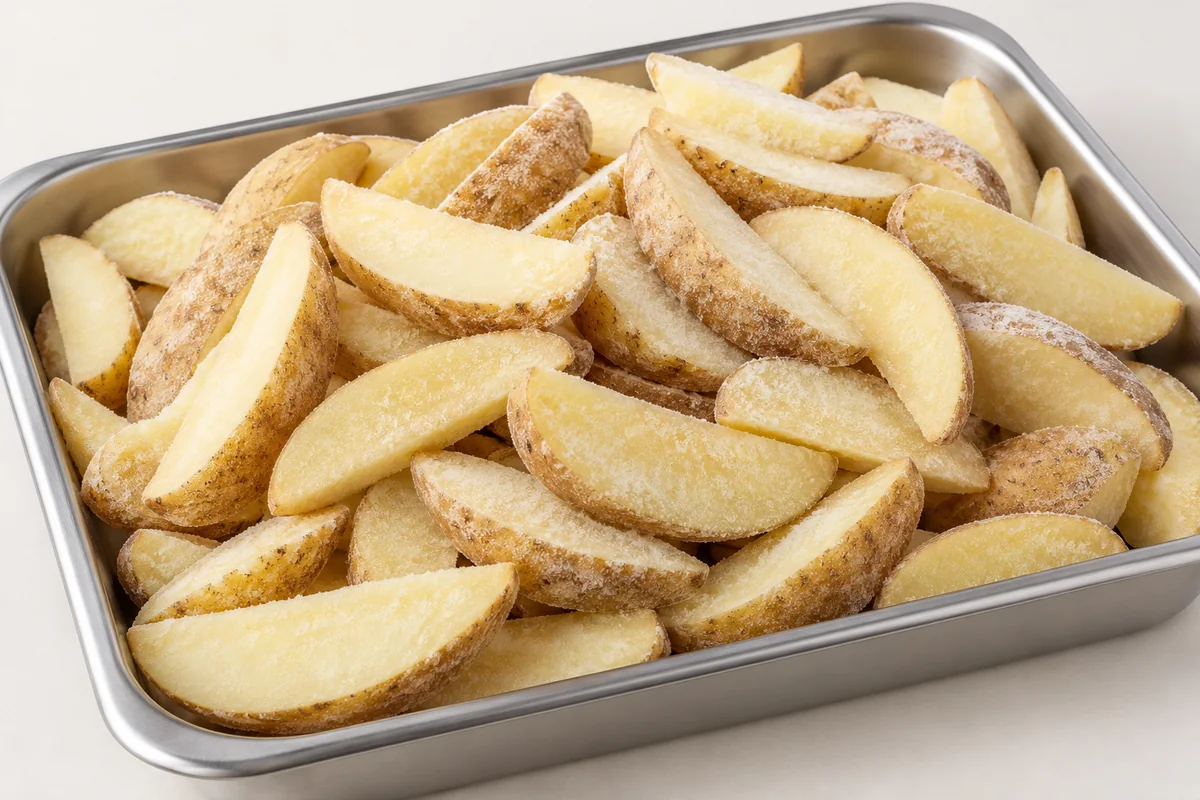
Separate the skin, seasoning and coating decisions
A frozen potato wedges wholesale enquiry should describe more than the product name. State the intended channel, such as a foodservice distributor, restaurant group or retail buyer-brand programme. Then identify the skin preference, cut, seasoning and coating as separate fields. A skin-on item can have a different recipe and preparation method from another skin-on item.
Official producer listings illustrate these distinctions. McCain Canada identifies a particular skin-on wedge as uncoated, while its MENA catalogue describes a different seasoned skin-on item with a coating. Aviko identifies its Jacket Wedges as pre-fried and quick-frozen. These are individual producer examples, not declarations of TPJ ingredients, processing state or availability.
Ask which offered item matches the brief and request its current specification. Keep plain or seasoned, coated or uncoated, and processing state explicit in the sample record. Do not assume that an unseasoned description means a single-ingredient product, or that a frozen wedge is ready to eat.
Define wedge geometry and the acceptable piece mix
A wedge is not described adequately by the same cross-section dimensions used for a straight-cut fry. Agree how length, width at the broad end and thickness will be measured, and in which product condition. Include a reference photograph or physical sample when the customer requires a particular presentation.
A named cut count is another field to clarify. McCain’s Canadian item, for example, includes a cut count in its product name. That does not by itself provide the piece-weight distribution needed for your portion plan. Ask for the offered specification and define piece-size or piece-weight criteria with the supplier rather than assuming a universal wedge size.
Describe how to record small pieces, broken tips, skin condition, discolouration and other agreed defects. Set the sampling quantity, assessment method and permitted variation together. Retain photographs showing what purchasing and kitchen teams accept, so a phrase such as large wedges does not substitute for a measurable brief.
Review the actual ingredient and preparation documents
Request the complete ingredient declaration and allergen information for the exact sample, including coating, seasoning, oil and any other ingredients present. McCain’s named MENA seasoned wedge lists wheat flour within its coating and declares gluten. This is a reason to check each SKU; it does not establish the allergen status of other wedges or a TPJ product.
If the buyer needs a particular flavour, dietary claim or ingredient restriction, specify it before sample approval. Ask the selected producing facility to confirm feasibility and provide supporting documents for the item and destination. Review revised declarations when the recipe changes, including any effect on buyer-brand artwork.
Confirm the offered processing state and the product-specific storage and final preparation instructions. Equipment suitability must be established for that item. A fryer or oven method published for one manufacturer’s product does not approve an air-fryer process, preparation temperature or cooking time for another.
Run a wedge-specific sample and portion trial
Identify each sample by supplier, SKU, lot or sample reference and specification revision. Inspect the frozen pieces before preparation, then follow the confirmed instructions for each candidate. Record equipment, batch loading and preparation conditions, including any differences required by the individual items.
Assess the potato centre, outer finish, seasoning distribution and piece integrity at the customer’s intended serving stage. Where a holding or takeaway process is relevant, reproduce that workflow with the intended packaging and record the assessment interval. Approve the result from the trial instead of assuming a universal crispness period.
| Buyer check | Agree before the trial | Record for each candidate |
|---|---|---|
| Sample identity | Offered item, recipe and specification revision | Supplier, SKU, lot or sample reference and receipt condition |
| Piece mix | Measurement points, size or weight criteria and intact-piece definition | Measured distribution, broken tips, small pieces and accepted examples |
| Preparation | Confirmed instructions and intended kitchen equipment | Starting quantity, actual conditions, draining and assessment stage |
| Serving acceptance | Centre texture, outer finish and seasoning target | Accepted pieces, exclusions and reasons for rejection |
| Portion basis | Serving weight or agreed piece count with size criteria | Complete accepted portions and any remaining usable product |
| Packing | Bag and case net quantity, identification and handling | Received case condition, pack configuration and observed breakage |
Compare accepted portions and equivalent commercial packs
Agree whether the menu portion is defined by prepared weight or by an accepted piece count. If using a count, keep the piece-size criteria alongside it. Record complete portions and usable remainder separately; the same bag weight does not guarantee the same number of accepted servings.
For a product-cost comparison, divide the cost of the tested quantity by the complete portions meeting the agreed standard. Use the same cost boundary for each candidate and identify any remainder. Keep freight, labour, oil and energy separate unless both calculations include them consistently. For a weight-based serving, the linked portion-cost tool can use your measured trial inputs; it does not provide an assumed wedge yield.
Confirm inner-bag net weight, bags per case and case net quantity together. Review protection against breakage, lot marking and handling across the intended distribution route. For a private-label enquiry, confirm the selected recipe and pack feasibility before artwork approval or a commercial commitment.
Send a focused wholesale potato wedges RFQ to TPJ
Send TPJ the intended application, skin preference, cut and piece criteria, seasoning or coating brief, ingredient requirements and preparation equipment. Include the portion definition and sample acceptance record where available, rather than asking only for the lowest carton price.
Add the proposed bag and case configuration, destination country or port, expected purchasing volume, shipment window and requested quotation basis. Ask for the offered item’s current specification, representative sample and applicable producing-facility documentation. Availability, MOQ, lead time, packing options and commercial terms are confirmed for the proposed order.
Technical references
These references explain specification terminology and buyer checks. Third-party grades, recipes and performance claims do not establish the specification of a TPJ product.
Use this checklist as a discussion guide. Product availability, technical values, certification scope and destination eligibility are confirmed for each selected item and producing facility.