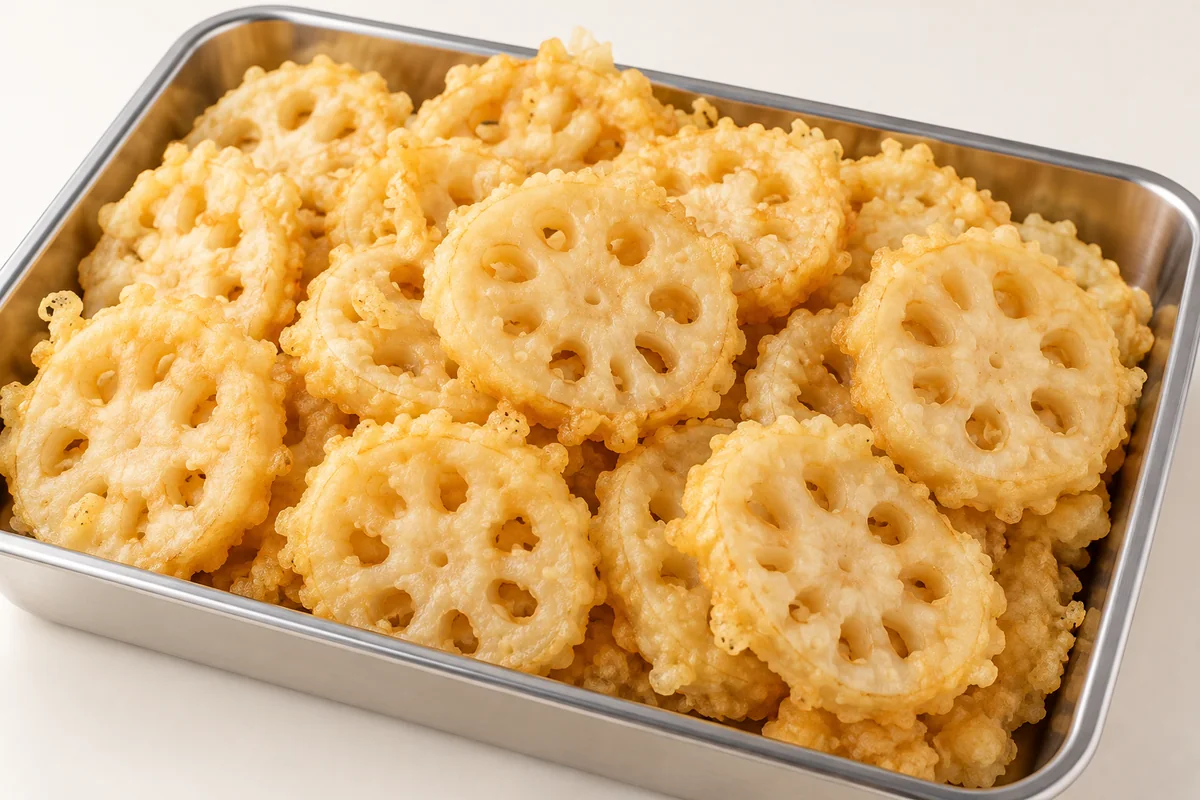
Identify the coated product and its processing state
For importers, appetizer distributors and restaurant groups, a frozen tempura lotus root enquiry should identify the finished coated item. Uncoated frozen lotus root slices, battered slices for further cooking and finished snack chips are different purchasing briefs. Confirm the proposed item instead of treating these names as interchangeable.
Ask the supplier whether the offered product has been pre-fried and obtain its actual preparation instructions. Maruha Nichiro’s 2024 professional-food catalogue, for example, identifies its own lotus root tempura as a non-pre-fried item. That historical product example shows why processing state needs a separate question; it does not describe a TPJ recipe, current availability or an interchangeable cooking method.
Record the intended application: an individually plated side, a mixed tempura assortment, catering or a retail cooking product. Tell the supplier which equipment and service process will be used. Frozen appearance alone does not establish cooking status or suitability for that process.
Specify slice geometry and what counts as an acceptable piece
State whether the brief calls for round cross-cut slices or another agreed cut. The same manufacturer’s catalogue describes an angled slice for its particular item, illustrating that the cut should be written down rather than inferred from the words lotus root tempura. Match the quotation, reference photograph and sample to one defined format.
Agree how thickness and size will be measured, including whether the measurement is taken on the vegetable or the finished coated piece. For an angled cut, define the relevant long and short dimensions. Record permitted variation and a sampling method instead of requesting an undefined uniform size.
Natural perforations are part of the visual buying brief. Specify the required presentation, including coating coverage, visible holes where relevant, edge condition and acceptable fragments. The following worksheet provides fields to agree with a manufacturer; it does not impose numerical TPJ tolerances.
| Buyer check | Define before sampling | Record against the sample |
|---|---|---|
| Cut and dimensions | Round or agreed alternative; measurement points and condition | Thickness and size distribution using the agreed method |
| Piece integrity | Definition of intact slices, edge damage and fragments | Accepted pieces and exclusions from an identified sample quantity |
| Perforations and coating | Required visible pattern, coverage and permitted bridging of holes | Photographs of accepted and rejected examples |
| Preparation status | Offered processing state and SKU-specific cooking instructions | Instructions followed, equipment and actual trial conditions |
| Prepared serving | Colour, coating adhesion and lotus root texture at service | Assessment stage, accepted portions and rejection reasons |
| Packing and identity | Inner-pack and case configuration, lot marking and handling | Received condition, sample reference and specification revision |
Approve the batter and ingredient information separately
A lotus root slice is only one part of the coated product. Request the exact ingredient declaration, batter or seasoning description and allergen information for the proposed SKU. Confirm how the coating target is defined and measured if it forms part of the commercial specification.
Keep dietary claims separate from the vegetable name. Do not assume that a vegetable-based product or a vegan claim establishes allergen-free status. The UK Food Standards Agency’s business guidance specifically distinguishes vegan and free-from claims and discusses cross-contact risk. For a UK brief, use that guidance alongside the actual product documents; for other destinations, have the buyer’s responsible team confirm the applicable requirements.
Resolve recipe, claim and labelling questions before artwork approval or a trial order. If a recipe changes after sampling, obtain the revised declaration and reassess the affected requirements rather than relying on the earlier sample approval.
Inspect the frozen sample, then run a recorded kitchen trial
Start with the received frozen product. Identify the supplier, sample code, lot, specification revision and condition on arrival. Record clumping, observed loose coating and broken slices against the agreed inspection method. Photograph the sample before preparation so transport damage is not confused with a kitchen result.
Follow the confirmed instructions for each candidate. Record equipment, batch load, preparation conditions and draining or serving steps. When comparing two items, document any necessary differences in their approved methods instead of applying one assumed temperature or time to both.
Assess coating adhesion, visible slice presentation and lotus root texture at the intended serving stage. If the customer uses a holding or takeaway process, reproduce that workflow and record when the sample is assessed. Use the resulting accepted pieces or portions in the commercial comparison; avoid promising a universal crispness period or yield.
Connect usable portions to packing and quotation terms
Confirm whether the quotation is based on finished coated product weight, and state inner-pack net weight, packs per case and case net quantity. A portion specified by slice count also needs an agreed piece-size and acceptance basis; equal bag weights do not necessarily provide the same number of usable servings.
Compare the product cost of the tested quantity with its accepted portions under one consistent cost boundary. Keep freight and other operating costs separate unless both offers include them on the same basis. Do not calculate with an assumed coating ratio or portion yield that has not been agreed or tested.
Ask how the proposed packing protects slices during storage, transport and handling. Review the producing facility, traceability information, case marks and destination documents relevant to the order. Buyer-brand packing, minimum quantity, lead time and shipment arrangements require confirmation for the selected programme.
Send a lotus root tempura RFQ that a supplier can assess
A focused wholesale RFQ links the customer’s presentation requirement to the product, sample and packing review. Send TPJ an existing specification or reference photographs where available, and identify which criteria are essential for sample approval.
Include the cut and dimension requirements, intact-piece and perforation presentation, coating and ingredient brief, preparation equipment, serving process, pack configuration, destination country or port, expected volume and delivery period. Request written confirmation of the offered processing state, sample identity and quotation basis.
TPJ can review this brief with the selected producing facility and discuss a representative sample. Confirm feasibility, current product documents, availability, MOQ and commercial terms before a buying commitment. The product page provides the enquiry route; the approved specification and sample record should define the order.
Technical references
These references explain specification terminology and buyer checks. Third-party grades, recipes and performance claims do not establish the specification of a TPJ product.
Use this checklist as a discussion guide. Product availability, technical values, certification scope and destination eligibility are confirmed for each selected item and producing facility.