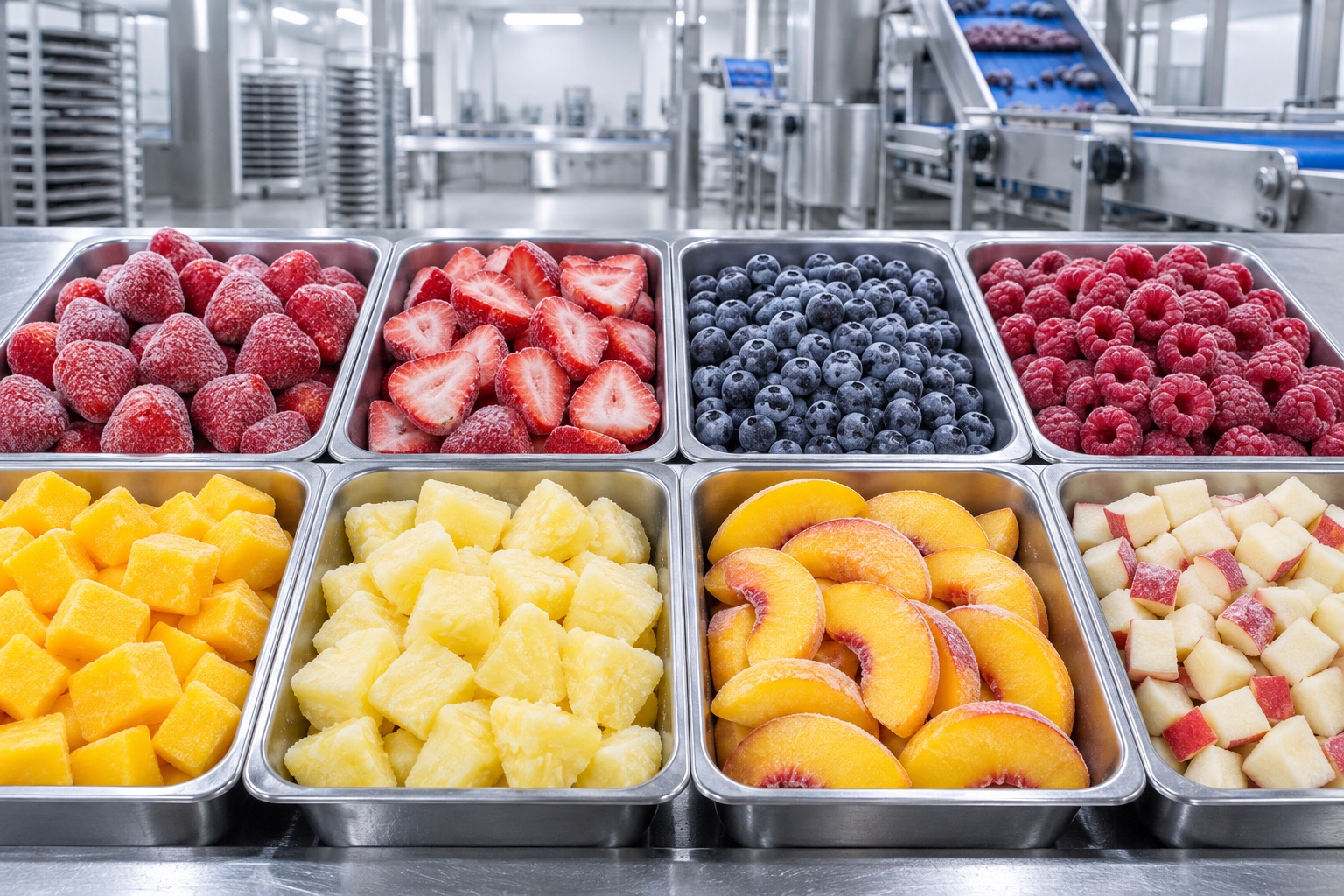
Choose the strawberry format around the finished application
A food manufacturer comparing whole and diced IQF strawberries should begin with the finished product. Will the fruit remain visible, be distributed as smaller inclusions, or undergo further blending and processing? Define the intended result before comparing supplier samples or prices. Both formats can be considered for more than one application; neither is automatically the better or cheaper choice.
Public producer catalogues illustrate this overlap. Dole lists diced strawberries for uses including sauces and smoothies, while Simplot lists a whole IQF strawberry product with dessert and drink uses. Use these examples to choose which formats to test in your own finished product. TPJ’s strawberry range lists whole, halves, slices and diced formats, with availability confirmed for the selected programme.
Define whole-fruit sizing and dice dimensions separately
For whole berries, write the size range, measurement direction and acceptable size distribution. For diced fruit, write the nominal dimensions, measurement or screening method, permitted variation and treatment of smaller fragments. A single word such as medium, or a cut name without a tolerance, leaves too much room for different interpretations.
The USDA frozen strawberry standard defines a whole-fruit diameter measurement perpendicular to the stem-to-tip axis. It describes whole and sliced styles; it does not supply a universal commercial dice dimension. If a buyer requests a named grade, identify the standard and its complete acceptance criteria rather than treating a size description as proof of grade. Record the agreed size and any confirmed grade in the product specification.
Use a strawberry-specific acceptance worksheet
Agree the sample quantity, inspection conditions and reporting units with the supplier. Record each requirement and supplier response before the trial, then add the observed result. Complete the framework below with the producing facility before approving the selected SKU.
| Field | Buyer requirement | Supplier and sample record |
|---|---|---|
| Fruit format | Whole, halves, slices or dice; intended application | Selected SKU and representative sample identity |
| Size distribution | Whole-fruit measurement or dice dimensions and variation | Measurement method and observed distribution |
| Broken pieces and fragments | Definitions, reporting unit and acceptable level | Separate results for each agreed observation |
| Appearance and trim | Colour reference and treatment of residual stems or calyx | Photos and inspection result under agreed conditions |
| Frozen condition | How clumps and free-flowing pieces will be assessed | Receipt condition and sample observation |
| Formulation and use | Ingredient requirements and intended further processing | Current ingredient declaration and use instructions |
| Packing | Bag net weight, bags per case and case net weight | Confirmed configuration and carton marking |
Compare samples in the same manufacturing trial
Use equal weighed inputs and keep the recipe, equipment, processing steps and observation times consistent. Record how the fruit distributes through the finished product, the visibility of pieces, colour, released liquid and the texture required by your application. If a process includes thawing or heating, document the agreed conditions instead of comparing one frozen sample with another under different conditions.
Evaluate the result in the actual product: a whole-berry presentation check answers a different question from a diced-fruit inclusion trial. Keep a record of the input quantity, retained or rejected material and accepted finished output. This allows the buying team to compare usable output on the same basis without assuming a yield advantage from the cut name.
Confirm ingredients, intended use and the case configuration
Request the full ingredient declaration, including whether anything is added to the fruit, and the handling or preparation instructions for the actual SKU. The term IQF describes the freezing format; it does not by itself establish ready-to-eat status or the instructions for a TPJ strawberry product. Review suitability for the intended use with the producing facility.
Write the net weight of each inner pack, the number of packs per case and the case net weight together. Confirm carton marking, pallet requirements and shipment timing for the programme. Ask for the available commercial configuration in the quotation, including any difference between the sample pack and the proposed order pack.
Send a complete wholesale strawberry enquiry
Send the target application, fruit format, size and defect criteria, ingredient requirements, expected order volume, release schedule, packing, destination market or port and required delivery period. Include the trial worksheet and photographs of the intended finished product where useful.
Ask TPJ for the available product specification and representative sample. Confirm the selected producing facility, relevant documents, actual pack and commercial terms before approving the supply programme. Use the related bulk-fruit guide for the broader sourcing and seasonal planning discussion.
Technical references
These references explain specification terminology and buyer checks. Third-party grades, recipes and performance claims do not establish the specification of a TPJ product.
Use this checklist as a discussion guide. Product availability, technical values, certification scope and destination eligibility are confirmed for each selected item and producing facility.