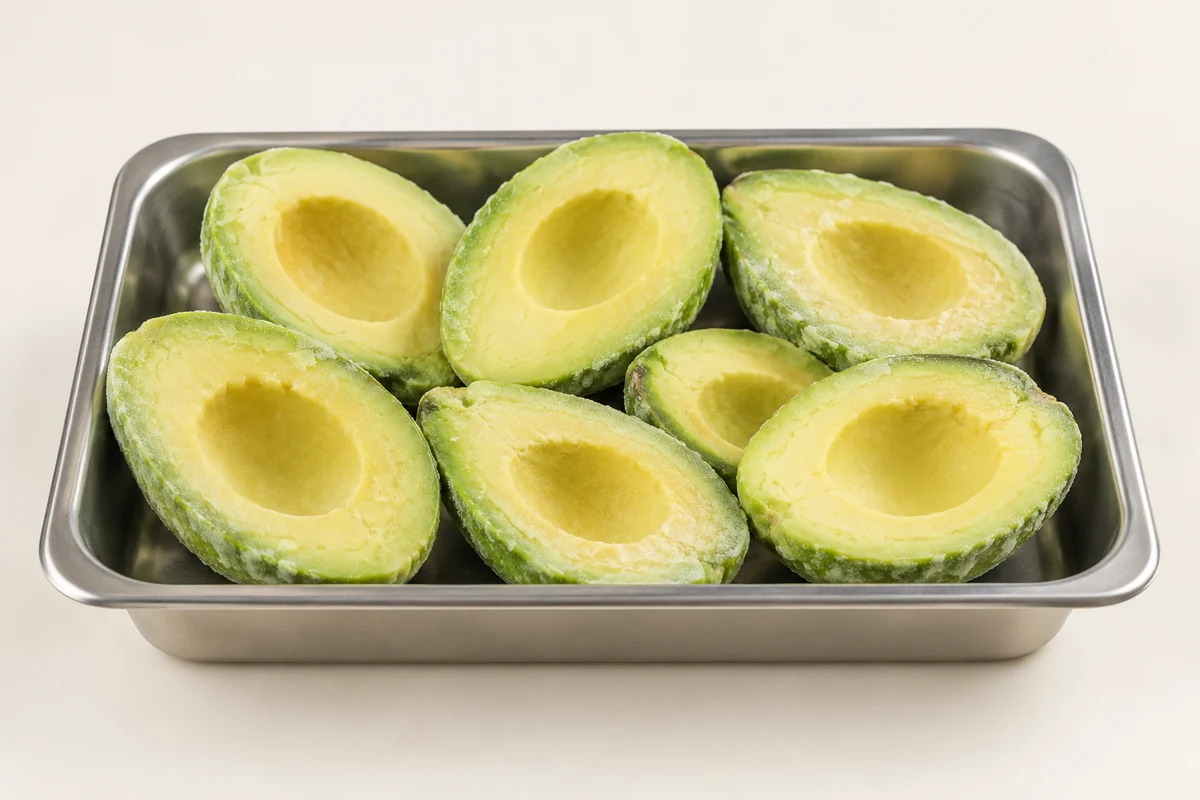
Choose the format around the finished application
A frozen avocado wholesale enquiry should start with the finished food and the buyer’s production or kitchen process. Decide whether you need a visible portion, discrete inclusions or a controlled-texture ingredient. Then specify the format and assess a representative sample in that application.
Halves, dice and puree are separate buying briefs. Simplot’s official catalogue, for example, lists frozen halves and diced avocado as distinct products with their own documentation. This is a useful reason to compare offered items by SKU; it does not establish the recipe, performance or preparation instructions of a TPJ product.
Use a format-specific comparison matrix
Write the acceptance criteria before comparing quotations. Halves can be reviewed where the brief requires an intact portion or buyer-controlled further cutting; dice where separate pieces matter; puree where the recipe calls for a blended ingredient. These are trial starting points, not guarantees of suitability.
Do not approve the format from an attractive image alone. Record what will be measured, the product condition during assessment and the permitted variation. For puree, clarify whether the requested texture is smooth or includes defined pieces.
| Format | Buying brief | Define before sampling | Check in the actual application |
|---|---|---|---|
| Halves | Intact portions or buyer-controlled slicing and further preparation | Peel and pit status; piece-weight criteria; integrity; maturity and color | Accepted intact pieces, texture and appearance after the item’s approved preparation |
| Dice | Discrete pieces for a defined foodservice or manufacturing process | Nominal dimensions; tolerance; measurement method; fragments and fruit condition | Piece distribution, retained integrity and performance in the intended recipe |
| Puree | A smooth or defined-texture ingredient for further recipe use | Plain or formulated recipe; avocado content requirement; complete ingredients and consistency | Texture, consistency and recipe performance using an agreed assessment method |
Review ingredients, processing and handling by SKU
The word puree does not identify a complete formulation. One Simplot frozen pulp SKU lists avocado, lime juice concentrate and salt. That is a product-specific example, not a universal avocado recipe. Ask for the ingredient declaration of the exact item being offered.
State whether your brief requires plain avocado or permits a formulated product. Review any salt, acids, color-control additives or other ingredients actually present. Include relevant customer and destination requirements, and resolve differences before sample approval rather than assuming products with similar names are interchangeable.
Westfalia describes its selected diced avocado product as IQF. An offered product’s freezing format still needs its own confirmation. IQF, frozen storage and a named processing treatment describe different aspects of a product; do not use one term as proof of another.
Request the current product specification and actual preparation instructions. Confirm storage, transport, unopened and opened handling, intended use and any further processing required. Do not borrow a competitor’s thawing schedule or shelf life, or infer ready-to-eat status from a format name. The offered SKU’s approved documents control the trial.
Keep a repeatable sample and acceptance record
A useful trial should allow the buyer and supplier to discuss the same item under the same conditions. Record the sample identity, specification revision and actual preparation followed. Assess maturity, color, texture and defects against agreed criteria rather than using an undefined judgement such as good quality.
For manufacturing, assess the avocado in the intended recipe or process. For foodservice, record the relevant preparation and service evaluation stage. Define exclusions consistently, and enter your own accepted output or usable portions when comparing cost. A lower price per kilogram alone does not establish equivalent usable output.
- Supplier, SKU, lot or sample reference, receipt date and specification revision
- Actual preparation instructions followed, equipment or process, and assessment stage
- Halves integrity and piece criteria, dice dimensions and fragments, or puree texture and consistency
- Agreed color, maturity, defect and ingredient acceptance criteria
- Trial input, accepted output, excluded material and the calculation basis
- Results, photographs, decision and any specification or sample revision requested
Align packing and the commercial comparison
Agree inner-pack weight, case configuration, net quantity, case marks and the expected order or release schedule. A foodservice bag, industrial ingredient pack and retail buyer-brand brief may need different handling and packing reviews. Confirm feasibility for the selected item instead of assuming every format has identical pack options.
Compare the same currency, delivery basis and included costs. Keep product cost and other cost items clearly identified. Request the named producing facility, traceability information and current product or destination documents relevant to the order. Confirm availability, minimum quantity, lead time and commercial terms during quotation; this guide does not set those values.
Send a complete frozen avocado RFQ to TPJ
A precise brief helps TPJ coordinate a focused product, sample and packing review. Identify the format first, then explain the finished application and the criteria that will determine approval. Attach your existing specification or acceptance worksheet if available.
Use the corresponding halves, dice or puree product page to submit the enquiry. Actual formulation, producing facility, freezing format, available packing, documents and supply terms are confirmed for the proposed order. An illustrated catalogue entry is a starting point for qualification, not proof of current stock or an approved sample.
- Halves, dice or puree, intended use and destination country or port
- Variety requirements if relevant, peel and pit criteria, dimensions or texture brief
- Complete ingredient and additive requirements, analytical needs and quality limits
- Required freezing or processing information and actual preparation expectations
- Representative sample, agreed measuring method and acceptance criteria
- Bag and case configuration, buyer-brand requirements and expected quantity
- Preferred delivery terms, shipment window and any required documentation
Technical references
These references explain specification terminology and buyer checks. Third-party grades, recipes and performance claims do not establish the specification of a TPJ product.
Use this checklist as a discussion guide. Product availability, technical values, certification scope and destination eligibility are confirmed for each selected item and producing facility.